Ancient Medicine Can Heal, No Kidding
People in the West know Chinese medicine for acupuncture. But the bulk of Chinese medicine is actually about herbal remedies. Chinese herbal medicine essentially has been in its present state since about 2500 years ago when it was systemized–when it stopped being shamanic and became based on natural events.
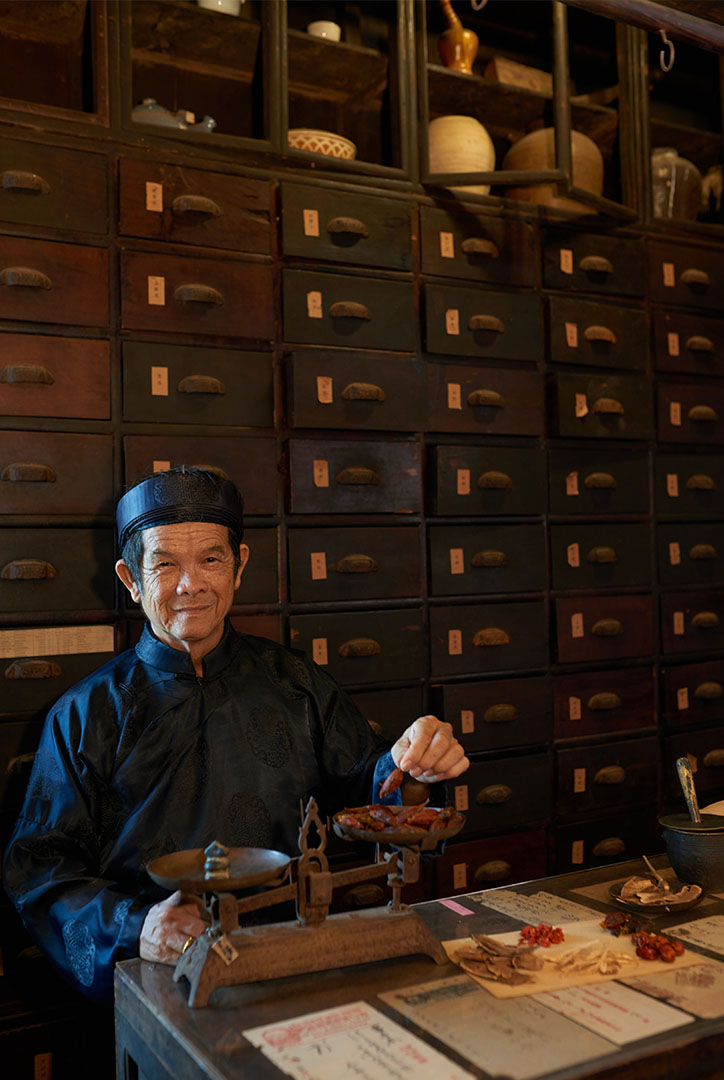 Medicinally, we work with 3 basic types of herbs:
•Nutritional herbs. The concept that food is medicine has long been understood in Chinese medicine. Ginger, for example, is both a food and a medicine. Nutritional herbs are usually potent superfoods that have medicinal effects.
•Adaptogens. These are regulatory and do not add or subtract energy. For example, they can help build hormones or help them work without draining any energy.
•The third type is the truly medicinal. The stems of ephedra will make you sweat; the roots will stop you from sweating. These are anti-microbial, antiparasitic, anti-inflammatory, antifungal, and herbs that can be used to enhance blood circulation or stop bleeding. Truly medicinal herbs are like drugs because they work by forcing the body do something, which uses the body’s energy.
The way an herb is processed will alter its effects. The way you soak it, cook it, and extract it will alter its effects. If an herb is prepared with vinegar versus ginger, there will be a different effect, for example. Herbal pharmacists are extensively trained in this. If you know the herbs, you can smell and feel their quality.
What is most potent? The herbal decoction – the brewed liquid form – is the most potent and quick-acting. Second most potent are the granules/capsules. Third in line are the pills.
The dosage you see on supplement bottles is normally set at the maintenance dose. The loading dose tends to be at least double.
The TCM Way of Deciding Which Herbs to Use
People today typically present with a bunch of patterns going on at the same time.
 When I work with a client, the first thing I do is look for these patterns. If the person is overweight, that tells me there is dampness (pathogenic fluid retention) because there are two types of fluid – water and oil. Oil is greasy like fat, and it is damp. Are they more of a yin or a yang person? Yang people are more intense, energetic, ruddy complexioned, and tend to get illnesses like that – more intense but short-lived. Yin people are more soft spoken, laid back, cooler, pale complexion types, and their illnesses tend to be not so intense but of a long duration.
Is what is being experienced from an excess or deficiency of heat, or an excess or deficiency of cold? Think of turning on the sink faucet handles equally; the temperature is neutral. This is homeostasis in the body –the forces of yin and yang are equal –there is no excess or deficiency. But if something causes you to be hotter, like chronic inflammation, then you have excess heat. By our analogy, the hot water faucet is turned too high. If you have the normal amount of yang/heat but you turn down the cold faucet, then the water will feel hot. But the treatment is not to turn down the hot water faucet because then the person would be low in everything and they’ll get sicker. The treatment is to turn the cold back up.
Western medicine often does the opposite. For example, if you have anxiety, doctors would prescribe a drug like Valium, Xanax, or Ativan in an attempt to push down that anxiety, to make the symptom go away. But when you work with herbal medicine, you think to fortify the body so the person can tolerate the outside stressors better and better deal with them.
 Now let’s flip this and look at the cold side of things. Take the woman going through menopause and having hot flashes. Typically, her estrogen levels have gone down. Estrogen is the most yin substance, very cooling. The Chinese call a hot flash “empty heat.” You are not having a hot flash because there is too much heat in the body; you are having hot flashes because the cooling system has shut down. The treatment is not to cool off the system, but to add yin to the system to balance the yang.
By the way, there is a dot in the yin-yang symbol because nothing in nature is ever 100% yin or yang.
Which Formula is For You?
When working with a client, I want to decide if what they are experiencing is a case of excess or deficiency. Is there pain? What kind? Sharp pain is a case of excess–too much fluid, too much blood, too much energy, too much something in an area. Edema is a case of excess. There is too much fluid trying to get through a joint, it gets stuck, it hurts, and the body uses pain to communicate to you that it needs help.
A deficiency is a matter of the tissue not getting enough nourishment or energy. It feels sore and is uncomfortable, but not sharp or what we call “frank”pain. Often you can have both –upstream of the block is excess, downstream is deficiency. The river is not flowing freely. It hits a dam, a blockage or bottleneck of some sort.
Next thing I look for is where the blockage is in the body. Is it internal – in the organs or torso or brain? Is it external – in the skin, connective tissue, muscle, and outer parts of bone? It makes a difference in which formula will likely be successful.
Is it hot or cold? Are they more of a yin or a yang person? Yin is cold and yang is hot. Different herbs and their effects are described/understood in this way. Coconut oil, for example, is a yang tonic because it will warm you up – raise your metabolism and make you burn fat. I personally run so hot that if I take a lot of coconut oil, I turn red and feel feverish.
TCM teaches you to look at the health situation in terms of root and branch. By branch we mean the symptoms, and root means whatever is causing those symptoms. We always want to address both on some level. Sometimes just treating the root in a strong way will take care of the branch. Sometimes you need to address the branch separately.
There are at least a dozen categories of herbal formulas, and once I have the handle on what is causing your symptoms, I generate treatment principles to address the branch and the root. There are 8 principles – yin and yang pairs – that make up the TCM diagnostic system.
The Body’s Energy
One place where Eastern and Western medicine really take different paths is the concept of energy. Western medicine basically ignores it; TCM has great respect for it. Chinese medicine uses the term “qi” when talking about the body’s natural energy flow, the vital force of life. Yin and yang must be in harmony in order for qi to be in balance.
As TCM sees it, all medicines/drugs have a draining effect on the body. That is why the most common side effect of prescription drugs is drowsiness. The body’s innate wisdom recognizes the draining effect and starts getting rid of what’s causing it by detoxing (breaking down) the drug as blood is filtered through the liver and kidneys. The body sees non-nutritional herbs as drugs too and that is why you don’t stay on them forever. It’s the law of diminishing returns. Very commonly, prolonged use of energy – draining substances plunders the energy of the adrenals–not a good thing. The adrenals are the power pack for the hormonal system and are considered the battery of the life force.
Patients are commonly prescribed prednisone for pain. When they stop taking the prednisone, they often crash because their adrenal glands say, “Hey, the stuff we make is now coming from the outside so we don’t have to make it internally anymore.” And the adrenals kind of shut down. When prednisone first came on the market, doctors were advised not to prescribe it for longer than 3 weeks for just that reason. But it is now routinely prescribed for much longer periods. Clients have come to us post-prednisone with crushing fatigue because Western medicine schools do not teach doctors to support the adrenals, the batteries. As one client said, “When I came off of 18 months of prednisone, I made people with Chronic Fatigue Syndrome look like energizer bunnies. How do I get my energy back?” Chinese medicine has answers for this problem.
Drugs basically force the body to make something happen. They intervene in bodily functions and take over. The same thing happens with recreational drugs – marijuana, cocaine, etc. You get a high and then you crash. What happens with the energy will vary from drug to drug but the after-effect is quite similar: You will be drained.
When a person is low in energy, herbs can address the core issue and you can feel the effect right away. Take ginseng, for example. You feel a boost immediately, but it may take 3-6 months before that herb is done “filling up your tank.” The symptoms may go away quickly, but it may take months of support to enable the body to resolve the core issue.


The Power of Phytochemicals
The good news for mankind is that we have not lost the healing herbs to damage to the rainforest or climate change. Nature’s medicine cabinet is still intact.
“Wildcrafted” are the best herbs. They were picked in their natural setting and they tend to be stronger than herbs that are grown in a hothouse or farmed. Herbs that grow in the wild experience more stress to survive and that causes them to produce phytochemicals to protect themselves. Phytochemicals are superstars; they are healing tools for humanity.
Phytochemicals is a big, big subject, so I’ll keep this simple: When a plant produces a fruit or something we can eat, the fruit grows by the process of photosynthesis –the interaction of sun, air, soil, and water. The plant is also making phytochemicals to protect itself against competitors, pathogens, and predators. These phytochemicals are stored in its roots. While the sun falls on the fruit, it grows and matures. When the fruit is ripening, however, the plant then pulls up the phytochemicals and inserts them into the fruit because now the sun begins to act as a deteriorating force. By pulling up the phytochemicals, the plant is essentially putting on sunscreen internally. If you pick the fruit and plants before they ripen, you’ll miss out on the phytonutrients. This is one of the downfalls of today’s global food distribution system –many things are intentionally picked before they are ripe so they can withstand the timetables of national and international travel to make it to the produce aisle before they rot.
Ever wonder why there is so much chronic disease these days? One school of thought in nutrition circles is that we are missing out on many of the phytochemicals people got generations ago when they ate locally produced food.


Wildcrafted herbs are going to deliver way more results than herbs that were carefully grown in more protected, less stressful conditions.
Eastern Versus Western Herbs
In recent times, people have made an effort to understand Western herbs in the same way Chinese herbs are understood, but you can’t replace thousands of years of experience. So, it is best to use the herbs from China when practicing TCM.
The Chinese government has its own version of the FDA that regulates herbs. The issues that come to mind when we think of the Chinese government and its politics have little effect on TCM. Protection of herbs is deeply rooted in the culture.
The Chinese organize their formulas according to the analogy of the Imperial Court. The chief herb or herbs are considered the Emperor herbs. Herbs that assist the Emperor herbs in doing what they door address the problem in a different way are considered Minister herbs. Then more minor helpers are called Assistant herbs. The last category is called Ambassador or Guide herbs. Licorice root, for example, is the most common Ambassador herb because it acts to harmonize the effects of the various herbs in the formula. Ambassador/Guide herbs focus the treatment on a specific part of the body.
A Final Note
The medical system in China is a combination of ancient Eastern and modern Western medicine. Just as you can walk better on two legs than one, the Chinese feel they can produce better health outcomes by using the broad range of knowledge available in both the East and the West. Hence the expression that the modern Chinese medical approach is “walking on two legs.”
 When Chairman Mao took over China about 1950, he had a billion people who needed healthcare and knew he could not afford thousands of hospitals. The Chinese medical community had become enthralled with a shiny new toy –this expensive thing called Western Medicine. Mao engineered TCM’s big comeback. Thus, China today has a dual system, that “walking on two legs” system.
The Chinese have done a great deal of research and studies about the combined use of TCM and modern medicine, and this research has substantiated their claims as to TCM’s efficacy.